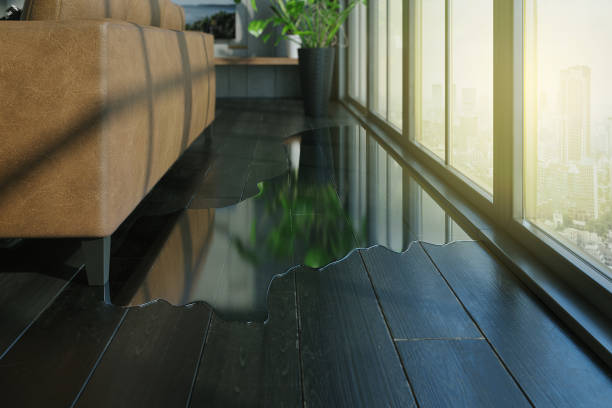
From historic heart-pine floors in the Oakleigh Garden District and Midtown cottages to solid red oak and engineered hardwood in Spring Hill and Fairhope homes, wood flooring is one of the most valuable features of a Gulf Coast property. Unfortunately, wood is hygroscopic — meaning it rapidly absorbs liquid water and water vapor until it reaches equilibrium with its surroundings. Acting within the first 24 hours of a leak can mean the difference between saving your existing floors and paying for a full tear-out.
How Water Damages Hardwood Floors: Cupping, Crowning, and Buckling
1. Cupping (Concave Edges)
When water from a dishwasher leak, burst pipe, or damp crawl space seeps beneath hardwood planks, the underside and lower edges of each board absorb moisture faster than the finished top surface. As the bottom of the plank swells, the left and right edges curl upward, creating a washboard effect across the room.
2. Crowning (Convex Center)
Crowning is the opposite of cupping — the center of each board sits higher than its edges. Crowning almost always happens when someone sands a cupped floor before the wood has been completely dried back to its normal equilibrium moisture content (EMC). Once the bottom of the plank finally dries and shrinks, the sanded edges drop below the center.
3. Buckling and Subfloor Separation
If water saturation is severe or left untreated, the lateral expansion of dozens of swollen floorboards exceeds the expansion gap at the walls. The planks push against each other with tremendous force, ripping the nails or adhesive free from the subfloor and heaving upward several inches.
Why Surface Mopping Alone Never Saves a Wet Wood Floor
Hardwood planks have tight tongue-and-groove joints, and most have a polyurethane or aluminum-oxide finish on top that blocks evaporation. Water that runs across a hardwood floor immediately slips between the seams and becomes trapped in a 'vapor sandwich' between the bottom of the hardwood, the tar paper or vapor retarder, and the plywood or concrete subfloor.
How Restoration Specialists Rescue Wet Hardwood Floors
Instead of prying up boards immediately, professional water damage technicians use specialized Negative-Pressure Floor Drying Systems:
1. Precision Wood Moisture Mapping: Using calibrated pin and pinless wood hygrometers to measure the exact moisture percentage of both the hardwood plank and the subfloor beneath it (normal indoor wood moisture in Mobile is typically 8% to 12%).
2. Suction Drying Mats (Rescue Mats): Flat rectangular vacuum panels are taped and sealed directly over the wet wood floor and connected to a high-static-pressure blower. The vacuum pulls trapped water and vapor straight up through the microscopic seams between floorboards.
3. High-Capacity LGR Dehumidification: Lowering the ambient room humidity so moisture releases evenly without cracking or checking the wood grain.
4. Crawl Space Sub-Drying: For pier-and-beam homes in Mobile, technicians simultaneously dry the underside of the subfloor from inside the crawl space to equalize moisture from both sides.
Editorial Standards & Official Restoration References
Every guide published by the RestoreMobileAL.com Editorial & Technical Team is aligned with nationally recognized water damage restoration, indoor air quality, and emergency preparedness standards for the Alabama Gulf Coast:
- ANSI/IICRC S500 & S520 Standards ↗Professional Water Damage Restoration & Mold Remediation Guidelines
- U.S. EPA Mold & Moisture Guide ↗Federal Indoor Air Quality & 24–48 Hour Drying Recommendations
- FEMA National Flood Insurance (NFIP) ↗Official Flood Coverage & Claim Documentation Rules
- Ready.gov Flood Safety Protocol ↗Electrical, Structural & Post-Storm Re-Entry Safety
Related Restoration Services in Mobile, Alabama
Explore our dedicated Mobile, AL service pages related to this guide:
Dealing with Water Damage in Mobile, AL?
Don't wait — 24/7 professional water extraction and structural drying minimizes damage and prevents mold growth.