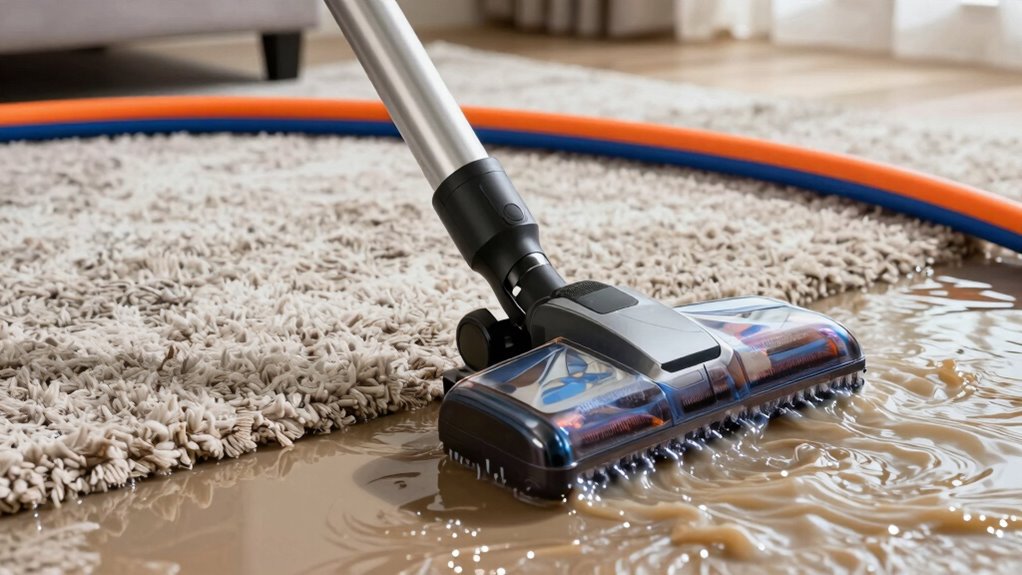
When a pipe bursts or a storm floods your home, the natural instinct is to grab towels, a mop, or a hardware-store wet/dry shop vacuum. While those tools remove surface puddles, porous building materials like carpet padding, OSB subflooring, oak planks, and gypsum drywall hold gallons of bound water that consumer tools cannot reach. Understanding how professional water extraction and psychrometric drying work explains why industrial mitigation is so effective.
Phase 1: Moisture Mapping and Contamination Assessment
Before turning on a single machine, technicians map the full perimeter of water migration using infrared thermal imaging cameras and pin/pinless moisture meters. Water frequently travels beneath baseboards into closets and adjacent rooms that look completely dry on the surface. Technicians also determine the water contamination category (Category 1, 2, or 3) and class of evaporation load (Class 1 through Class 4).
Phase 2: High-Volume Physical Water Extraction
Physical extraction removes liquid water 500 times faster than evaporation and dehumidification alone. Depending on water depth and flooring type, crews deploy:
Submersible Trash & Sump Pumps: Used when standing water is more than 1 to 2 inches deep, capable of pumping out hundreds of gallons per minute.
Truck-Mounted & Portable High-Lift Extractors: Generate powerful vacuum lift to pull water from carpets, tile grout, and concrete slabs.
Weighted Ride-On / Rover Extraction Tools: Use the technician's body weight to compress saturated carpet and foam padding while vacuuming, squeezing out up to 85% of trapped water without tearing the carpet fibers.
Negative-Pressure Hardwood Floor Drying Mats: Seal directly onto wet oak or pine floors with high-suction hoses to pull free water up through the tongue-and-groove seams from the subfloor below.
Phase 3: Establishing the Psychrometric Drying Chamber
Once all extractable liquid water is removed, the remaining bound moisture inside wood studs, drywall, and subfloors must be evaporated and removed from the air. Technicians balance three scientific variables — airflow, humidity (vapor pressure differential), and temperature:
High-Velocity Axial & Centrifugal Air Movers: Angled along walls and across floors to sweep away the microscopic boundary layer of saturated air clinging to wet surfaces, accelerating evaporation.
Low-Grain Refrigerant (LGR) Dehumidifiers: Unlike small household dehumidifiers that stop working efficiently below 50% relative humidity, commercial LGR units pre-cool incoming air to condense up to 130–200 pints of water per day, driving air moisture content (grains per pound / GPP) low enough to pull deep moisture out of dense wood framing.
Wall-Cavity Injection Drying Systems: Force warm, dry air through small 1/4-inch holes drilled behind removed baseboards to dry the inside of walls without demolishing the drywall.
Phase 4: Daily Moisture Logging and Dry-Standard Verification
Each day, technicians record indoor temperature, relative humidity, grains per pound (GPP), and material moisture content readings against unaffected 'dry standard' areas of your property. Equipment is only removed when meter readings confirm that studs, subfloors, and drywall have returned to safe, pre-loss equilibrium.
Editorial Standards & Official Restoration References
Every guide published by the RestoreMobileAL.com Editorial & Technical Team is aligned with nationally recognized water damage restoration, indoor air quality, and emergency preparedness standards for the Alabama Gulf Coast:
- ANSI/IICRC S500 & S520 Standards ↗Professional Water Damage Restoration & Mold Remediation Guidelines
- U.S. EPA Mold & Moisture Guide ↗Federal Indoor Air Quality & 24–48 Hour Drying Recommendations
- FEMA National Flood Insurance (NFIP) ↗Official Flood Coverage & Claim Documentation Rules
- Ready.gov Flood Safety Protocol ↗Electrical, Structural & Post-Storm Re-Entry Safety
Related Restoration Services in Mobile, Alabama
Explore our dedicated Mobile, AL service pages related to this guide:
Dealing with Water Damage in Mobile, AL?
Don't wait — 24/7 professional water extraction and structural drying minimizes damage and prevents mold growth.